
Earlier this year, I started another Data Collection Project – one taking a closer look at the role of moral injury during experiences of workplace abuse and neglect (low-morale experiences). Low-morale experiences reveal instances that likely include moral injury – leadership and collegial bystanderism, values abandonment, and more. In recent months, higher education and municipalities have abandoned long-standing values-based programs and missions, heightening the likelihood that employees are suffering from this phenomenon.
You may be wondering what moral injury is. The U.S. Department of Veterans’ Affairs offers a clear definition of the term. At press time, many government agency websites are being removed, censured, or redacted heavily. Due to the uncertainty of information availability, I’m offering a screenshot of the article, which has been traditionally available here.
You may also download a copy of the article.
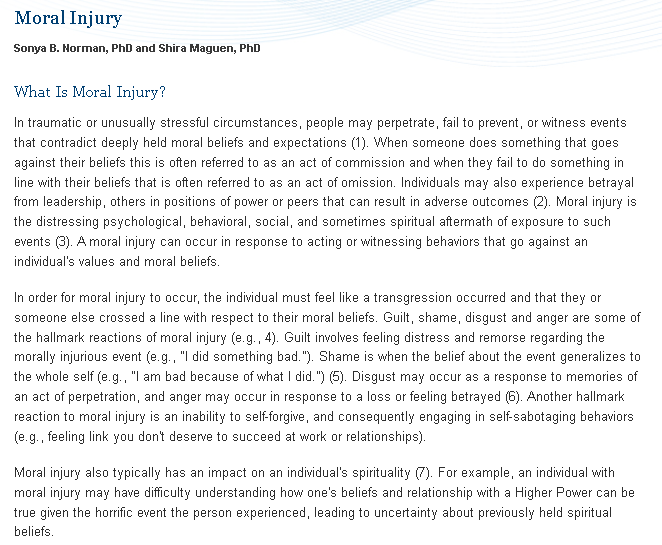
Considering these parameters alongside the broader definition of low-morale experiences (repeated, protracted exposure to workplace abuse or neglect – Kendrick 2017), I wanted to learn more about how moral injury can present – and how it further impacts victims. This will be the second report that is offered in three parts. This part will share quantitative data on respondent demographics and general low-morale experience/exposure to markers of moral injury; Part 2 will reveal qualitative data delving into narratives about impactful events of moral injury, and Part 3 will share more narratives detailing emotional, practice, and recovery strategies. These data reports reflect 31 respondents.
Low-Morale Experience
- 97% are female; 7% are non-binary; 3% are queer
- 77% are Caucasian; 13% are Latinx/Hispanic; 7%are African-American/Black
- 68% are currently experiencing low-morale; 7% aren’t sure they are currently experiencing low-morale
- Of those who are not currently facing low-morale, 71% have faced a low-morale experience in the past
- 38% have been dealing with/dealt with low-morale between 1 and 3 years; another 38% have been dealing with/dealt with low morale for more than 3 years
- 58% work(ed) in an academic library during their experience. 32% work(ed) in a public library. 9% work(ed) in a special library
- During their low-morale experience, their general role was
- 35% Manager/Supervisor/Department Head
- 32% Staff member (non-supervisory)
- TIE: 16.1% Administrator; Faculty member (non-supervisory)
- Kinds of abuse encountered:
- 98% Negligence
- 90% Emotional
- 77% Verbal/written
- 74% System
- 3% Physical
- Other items noted:
- “Lack of support”
- “Discrimination in 3 ways: race, religion, and gender: retaliation”
- “Ageism/disability discrimination”
- Abuse perpetrators:
- 77% Library administrators
- 74% Supervisors/managers
- 55% Co-workers/colleagues
- 52% Human Resources employees
- 19% Library users
- Was moral injury part of your experience?
- 87% Yes
- Tie: 7% No, Not Sure
Moral Injury (these data – and subsequent qualitative data – only reflect those who answered “Yes” or “Not Sure” to the “Was moral injury part of your experience?” query – 29 respondents; 94%)
- Which areas of moral injury experienced:
- 97% Experiencing betrayal from leaders or others in power – with harmful impacts
- 55% Doing something that goes against your beliefs
- Tie: 52% Not doing something that aligns with your beliefs; Experiencing betrayal from peers – with harmful impacts
- Types of distress suffered:
- 96% distressing psychological impacts
- Tie: 62% distressing behavioral impacts; distressing social impacts
- 34% distressing spiritual impacts
- Other items noted:
- “had to greatly increase therapy visits”
- Indicated emotions/actions felt/done:
- 89% Anger
- 57% Shame
- Tie: 48% Disgust; Guilt
- 34% Increased self-sabotage
- 27% Inability to self-forgive
- Other items noted:
- “Apathy – what is the point of maintaining high performance when its being actively undermined”
- “Self doubt”
- Anger and guilt”
- “Anger with myself for not researching the firm to see whether or not it was a safe place for me to work as a person of color. I thought it was safe when I first arrived. Six months in, I realized that was not the case.”
- “Questioned ability to make decisions/identify appropriate behavior.”
- Impact of injury on religious/spiritual outlook:
- 45% No
- 35% Not Sure
- 21% Yes
Part 2 is coming soon. If moral injury is/was part of your low-morale experience, you’re invited to participate in this ongoing Data Collection Project. I will report results periodically.
Renewals offers coaching for people who are facing workplace harm, or who are ready to recover and would like support and insight. Contact me to set up your Connection Call – and don’t forget to subscribe to the Renewals newsletter.
