
I think – pause before making any sort of a move. …Okay. Something happens, I need to stop and I need to think. Now, am I reacting out of a damaged place? Or am I reacting from healthy place? Let’s make sure that this reaction is coming from a healthy place.” – Participant, Low-Morale Experiences in Formal Leaders Study
In this series on Legacy Toxicity, I’ve shared context and offered signals of this low-morale experience Impact Factor for formal leaders. In this final part, let’s turn our attention to one of the most important things you can consider as a formal leader who is navigating Legacy Toxicity – and how you can get critically curious and create community to build strategies that may mitigate employees’ long-standing dysfunction and resistance to improving organizational culture.
Considering Leadership Styles: The Gap
Leadership (styles) is one of the original low-morale experience Enabling Systems – participants in all studies consistently identified formal leaders’ attitudes and behaviors as an influence on how workplace abuse and neglect were introduced and/or perpetuated. In particular, authoritarian and toxic leadership styles have been cited most often. In her book on toxic leadership in academic libraries, Ortega highlights how toxic leaders exact workplace abuse on employees:
Work cannot and should not be everything to librarians, because toxic leaders will abuse their dedication. These dedicated librarians will in
due course burn out …Work-focused lives seem to have in some cases unintentionally assisted toxic leaders with their exploitative behaviors
(2017, p. 20)
As you consider Ortega’s warning, take a moment and see if you can locate descriptors of your leadership style below.

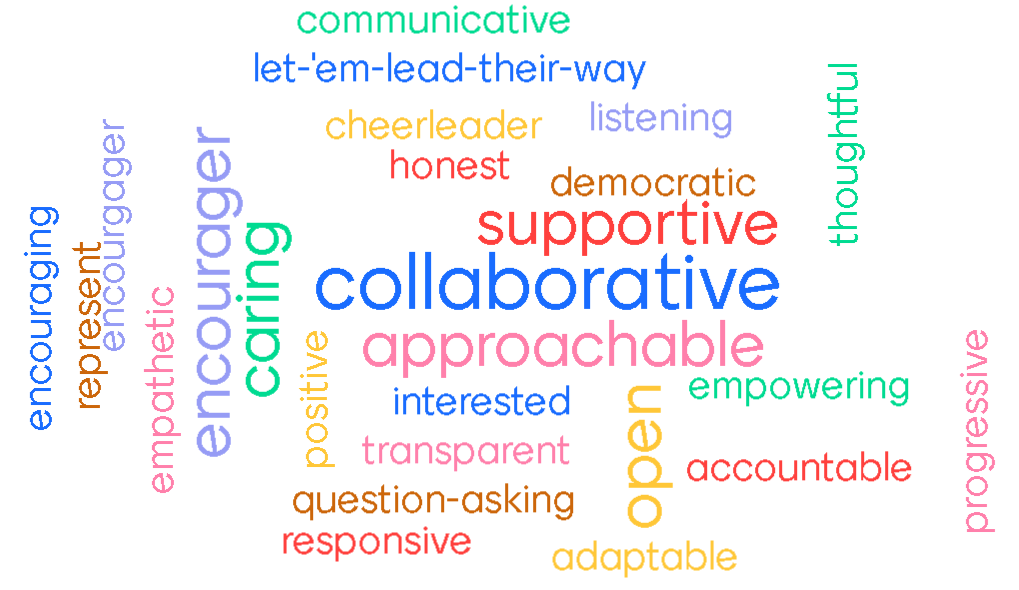

It’s likely that you see several adjectives or phrases that resonate with you, and it’s interesting to see what stands out among the different leader groups. However, these on-the-spot data from leaders reveal a gap: no one thinks they have a negative leadership style -yet, we know that workers are being exposed to negative leadership styles during their low-morale experiences. Within this gap, consider two things:
- How is your stated (likely positive) leadership style perceived by people who have dealt with entrenched workplace trauma?
- What is your shadow leadership style (authoritarian, toxic, laissez-faire)? When do the characteristics of your shadow leadership style show up (illness, exhaustion, overwhelm)?
An Intersection of Factors and Systems: Uncertainty & Mistrust and Leadership Styles
People who have dealt with workplace trauma may perceive stated collaborative leadership styles as intrusive – invitations to connect or open questions you ask about project details, interests, and the future may be perceived as precursors to a “set-up,” for instance. In some cases, your seemingly standard questions may inadvertently cause feelings of shame as you unwittingly uncover skillset gaps or overlooked lapses in workflows. Employees’ hypervigilant or defensive responses, in turn, expand feelings of suspicion and wariness for you and your reports. On the other end, laissez-faire behaviors you may do, like encouraging reports to ‘figure things out’ (as an ostensible pathway to ensuring employee autonomy, for instance), may lead traumatized employees to perceive you as disconnected and ineffective when they need help navigating the organization’s systems of recourse.
Surfacing Your Shadow Style
There may be aspects of your personality, ghosts of your own low-morale experiences, or behaviors you’ve adopted through observing others’ leadership style that you may not be aware of – and which influence your leadership and could be harming you or your direct reports. Are you conflict-avoidant? Do you engage in people-pleasing responses or behaviors? Are you a perfectionist? Do you overly rely on self-deprecation or sarcasm in your communication style? These could point to shadow styles that are ambivalent, authoritarian, or toxic.
Getting Critically Curious
Mitigating Legacy Toxicity requires individual and collective reflection via critical curiosity: engaging in empathetic inquiry and dialogue with people who are impacted by their experiences, and applying a trauma-informed lens during these dialogues. The goal is to move from feeling for to feeling with, and the outcome is to create a humane community of workers who feel safe enough to engage in their work, who are expected to disconnect from work appropriately, and who contribute positively to an improved workplace culture. Here are some selected queries for reflection:
- What do you need to reconcile in your past if you have experienced low-morale before coming to your current leadership role? Where do you need restoration and recovery?
- What role do you play in signaling recovery and care? What are your expectations for (in)direct reports’ engagement in recovery and care?
There are other questions that may come to mind – please share them below so other leaders may apply them as needed.
Thanks for joining me in these contemplations that help leaders recognize, realize, and reconcile how Legacy Toxicity shows up in our workplaces. To gain more insight, subscribe to the Renewals newsletter, and join us on Instagram, Threads, or Blue Sky!
Do you want to sunset your shadow leadership style? Are you ready to to create a plan for improving morale? Let’s set up a Connection Call!
